
Triumph Hurdle Racecard: Runners, Riders and Latest Declarations
Best Horse Racing Betting Sites – Bet on Horse Racing in 2026
Loading...
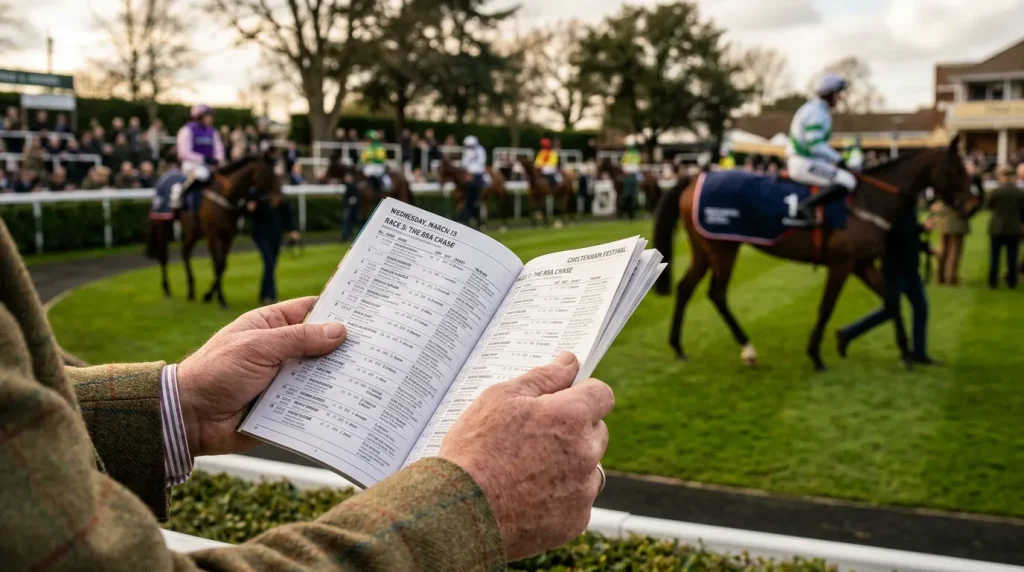
A Triumph Hurdle racecard is not a menu — it is a compressed data file. Every column, from cloth number to form string, encodes information about a horse’s readiness, connections and competitive profile. The confirmed runners list for this Grade 1 tells you who is actually showing up, and more importantly, who decided not to. Reading it properly means looking beyond names to trainer patterns, jockey allocations and the gaps where withdrawn horses used to sit.
How to Read a Triumph Hurdle Racecard
At first glance, a racecard for a National Hunt race looks like an overcrowded spreadsheet. Each row represents a declared runner, and the columns carry standardised information. The cloth number assigns each horse its saddlecloth for identification on course. In jump racing there is no draw — stalls are not used — so that column either appears blank or is absent entirely.
The weight column in the Triumph Hurdle is largely uniform. Every colt and gelding carries eleven stone; fillies carry ten stone seven. That consistency removes one of the biggest variables present in handicap racecards, where weight assignments can swing a race. In this contest, the weight column exists mainly to confirm whether a filly’s allowance applies.
Then come the critical fields. The trainer’s name tells you about the yard’s current form, resources and Festival record. The jockey booking tells you about stable hierarchy — if a top-yard operation has three runners and its number-one rider is on horse B rather than horse A, that signals internal confidence in ways that no public interview will replicate. Official rating, when available, provides a BHA-assessed snapshot of ability. And the form string — a sequence of digits and letters — captures recent race results in compact notation.
Key Columns for Betting Decisions
Form figures read right to left, with the most recent result on the far right. A “1” means a win, “2” a second-place finish, “0” means finished outside the first nine, “F” is a fall, and “U” an unseating. The Triumph Hurdle attracts lightly raced juveniles, so you will often see strings of just two or three characters. That is not a weakness in the data — it is the data. A horse with only one hurdle start and a “1” has won its only run. Whether that form is strong enough for a Grade 1 depends on the quality of what it beat and where it ran.
Days since last run is a column some racecards include and others require you to calculate. For juvenile hurdlers, freshness is not always an advantage. Horses who last raced at the Dublin Racing Festival in early February have had around five weeks between outings — a gap that is comfortable for most young horses. Those coming off a run in November or December face a longer lay-off that raises questions about fitness and preparation.
Headgear — blinkers, cheekpieces, a visor, a tongue tie — appears as a small notation next to the horse’s name. First-time headgear in a Grade 1 is a deliberate tactical move, usually signalling that connections want sharper focus from a horse who has shown ability but lacked concentration. It is a detail that recreational bettors routinely ignore but that professionals weigh carefully.
Official rating deserves its own attention. In an open Grade 1 like the Triumph Hurdle, ratings are not used to allocate weight, but they appear on the racecard as a comparative benchmark. A horse rated 145 has been assessed as considerably more talented than one rated 125, based on previous race performances. The complication is that juvenile hurdlers accumulate ratings quickly — a single impressive win can push a mark up by 10 or more pounds — so the number you see on racecard day may be based on only one or two data points. Cross-reference the rating with the form string and the grade of race in which it was earned. A 140 earned by beating a weak maiden field at a minor track is not the same as a 140 earned in a Grade 2 at Leopardstown.
Trainer form is the last column worth a systematic check. Some racecard providers show a trainer’s recent strike rate — say, three winners from the last fourteen runners. In the Triumph Hurdle, this matters because yards in purple patches tend to target the Festival aggressively, timing peak fitness for March. A trainer running cold heading into Cheltenham week is worth noting, even if the horse’s individual form looks good.
Declarations Timeline: When Runners Are Confirmed
Runners for the Triumph Hurdle are confirmed at the 48-hour declaration stage. For a Friday race, that means declarations close on Wednesday morning. Before that, the race may carry 20 or more entries, many of which are speculative — trainers keeping options open across multiple races. The declared field is materially smaller than the entry list, and the transition from entry to declaration is when the market sharpens most dramatically.
Non-runner announcements can arrive right up to race morning. This is where ante-post bettors without Non-Runner No Bet protection face their greatest risk. In 2026, the withdrawal of Narciso Has — the pre-Festival favourite — reshaped the entire market overnight. Any punter holding an ante-post slip on that horse without NRNB cover lost their stake entirely.
The number of horses in training across British racing has fallen to around 21,728 according to BHA data, a 2.3 per cent decline from 2026, and the shrinking population means that individual withdrawals carry proportionally more impact on field composition. In a race where the declared field might number only fifteen, losing the market leader does not just remove one horse — it redistributes the entire odds structure. Prices on remaining runners collapse, each-way terms may shift if the field drops below a certain threshold, and the entire value landscape changes within hours.
What to Watch For in This Year’s Card
Willie Mullins has won five of the last six Triumph Hurdles and typically declares multiple runners, sometimes as many as eleven from a single yard. When the racecard shows seven or eight Mullins entries, the jockey allocation becomes the single most important piece of information available. Paul Townend, as the stable’s number-one rider, chooses his mount based on private gallop reports and assessment of the horse’s Cheltenham suitability. Where he sits is a public disclosure of private intelligence.
Beyond jockey bookings, look at which Irish-trained runners have been supplemented — entered at an additional cost after the initial entry stage. A supplementary entry in a Grade 1 means the connections have seen enough in recent work or trials to justify a significant extra payment, which would be irrational unless they genuinely fancy the horse.
The racecard is where speculation meets commitment. Flutter Entertainment processed over 37 million online bets across Cheltenham Festival week in 2026, and a significant portion of that activity concentrated around racecard publication, when confirmed fields meet updated odds for the first time. Knowing how to extract signal from the card, rather than simply scanning names, is what separates the prepared bettor from the casual browser.