
Triumph Hurdle Odds Formats: Fractional, Decimal and American Explained
Best Horse Racing Betting Sites – Bet on Horse Racing in 2026
Loading...
UK bookmakers display Triumph Hurdle odds in fractional format by default — 5/1, 6/4, 11/8. But the betting landscape has diversified. Exchanges use decimal. International platforms use American. And the growing share of online gambling — remote betting now accounts for roughly 60 per cent of the total British market, up from 16 per cent just eleven years ago according to a Social Market Foundation report — means that punters increasingly encounter all three formats on their screens. Understanding how each works, and being able to convert between them, sharpens your ability to spot value in the Triumph Hurdle market.
Fractional Odds: The UK Standard
Fractional odds express profit relative to stake. At 5/1, a winning ten-pound bet returns fifty pounds profit plus the original ten-pound stake — sixty pounds total. At 6/4, ten pounds returns fifteen pounds profit plus stake — twenty-five pounds total. The fraction tells you: for every unit you risk (the right-hand number), you gain the left-hand number in profit.
Where beginners stumble is with odds-on prices. A horse at 4/6 means you need to stake six pounds to win four pounds profit. The denominator is larger than the numerator, signalling that the market considers this horse more likely to win than to lose. In the Triumph Hurdle, odds-on favourites have appeared — Detroit City at 8/11 in 2006, Sir Erec at 4/6 in 2019 — and their record is instructive: Detroit City won, Sir Erec was pulled up. Short prices do not guarantee short results.
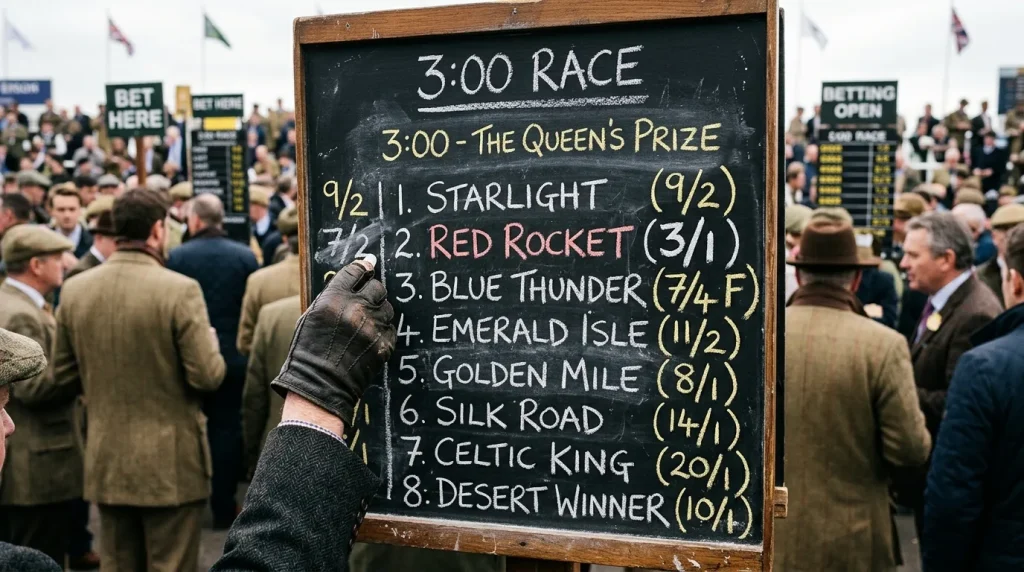
Fractional odds are deeply embedded in UK racing culture. On-course bookmakers chalk them on boards. Racing Post form guides list them. Commentators quote them. If you are betting on the Triumph Hurdle through a British bookmaker, fractional is the language of the market and fluency in it is assumed.
One common source of confusion is non-standard fractions. A horse at 11/8 or 11/4 requires slightly more mental effort than neat fractions like 5/1 or 3/1. The shortcut: multiply your stake by the top number and divide by the bottom number to get your profit. A twenty-pound bet at 11/4 returns twenty times eleven divided by four — fifty-five pounds profit — plus your stake back. Once you have done this calculation a few times, it becomes instinctive.
Decimal Odds: The Exchange Approach
Decimal odds express total return per unit staked, including the stake itself. A price of 6.00 means a one-pound bet returns six pounds total — five pounds profit plus the one-pound stake. A price of 2.50 returns two pounds fifty. The number is always higher than 1.00 because it includes the original stake.
The advantage of decimal odds is transparency. At a glance, 6.00 is obviously a bigger price than 4.00. In fractional terms, the same comparison — 5/1 versus 3/1 — requires mental arithmetic to reach the same conclusion. For quick assessments of relative value across a fifteen-runner Triumph Hurdle field, decimal is faster.
Decimal odds also make implied probability calculation straightforward. Divide one by the decimal price: 1 divided by 6.00 equals 0.167, or a 16.7 per cent implied probability of winning. For the Triumph Hurdle, comparing implied probabilities across all runners reveals the bookmaker’s overround — the built-in margin that ensures the percentages sum to more than 100 per cent. That overround has averaged 121 per cent across the last twenty renewals, meaning the bookmaker expects to pay out roughly 83p for every pound wagered.
Exchanges like Betfair default to decimal odds. Since exchanges match bettors against each other rather than against a bookmaker, the prices tend to be more efficient — closer to true probability — and the overround is replaced by a commission on winning bets, typically around five per cent. If you are comparing Triumph Hurdle prices between a traditional bookmaker and an exchange, converting everything to decimal removes ambiguity.
A worked example: a bookmaker offers a Triumph Hurdle runner at 7/1 fractional, which is 8.00 decimal. The same horse trades at 8.60 on the exchange. The exchange price is better, but after a five per cent commission on winnings, your effective return at 8.60 is 8.22. Still better than 8.00, but the margin is thinner than the headline price suggests. Doing this comparison in fractional format would require converting both prices, factoring the commission, and comparing the results — a process that decimal handles in a single step.
American Odds: Plus and Minus Explained
American odds use a baseline of 100 and express either the profit on a 100-unit stake (for positive prices) or the stake required to win 100 units (for negative prices). A Triumph Hurdle horse at +500 means a hundred-pound bet returns five hundred pounds profit. A horse at -200 means you must stake two hundred pounds to win one hundred pounds profit.
Positive American odds correspond to fractional odds where the numerator is larger: +500 equals 5/1. Negative American odds correspond to odds-on prices: -200 equals 1/2. The crossover point is even money, which is +100 or -100 depending on convention.
British punters rarely encounter American odds unless they use international platforms or read US-facing racing content. The total gross gambling yield across the British market reached £16.8 billion in the financial year ending March 2026, with the overwhelming majority of horse racing activity conducted in fractional or decimal format. American odds are included here for completeness and for the growing number of bettors who operate across multiple jurisdictions.
Quick Conversion Table for Common Triumph Hurdle Prices
| Fractional | Decimal | American | Implied Probability |
|---|---|---|---|
| Evens | 2.00 | +100 | 50.0% |
| 3/1 | 4.00 | +300 | 25.0% |
| 5/1 | 6.00 | +500 | 16.7% |
| 8/1 | 9.00 | +800 | 11.1% |
| 10/1 | 11.00 | +1000 | 9.1% |
| 16/1 | 17.00 | +1600 | 5.9% |
| 25/1 | 26.00 | +2500 | 3.8% |
| 33/1 | 34.00 | +3300 | 2.9% |
| 50/1 | 51.00 | +5000 | 1.9% |
| 100/1 | 101.00 | +10000 | 1.0% |
The implied probability column is the one that matters most for betting analysis. When a Triumph Hurdle runner is priced at 10/1, the bookmaker is implying a 9.1 per cent chance of winning. If your own assessment, based on trial form, trainer record and trend data, puts the horse’s true chance at 15 per cent, you have found a value bet — the price is offering better odds than the horse’s actual probability warrants. That gap between implied and assessed probability is where profitable betting begins, regardless of which odds format you prefer to read.
Most betting apps allow you to switch between formats in the settings menu. If you are comfortable with fractions but want to sharpen your probability instincts, try switching to decimal for a week. The adjustment period is short, and the clarity it brings to value identification — particularly in a crowded fifteen-runner Triumph Hurdle market where small probability differences determine the edge — repays the effort many times over.