
Betting Shop vs Online Horse Racing Betting
 Available in US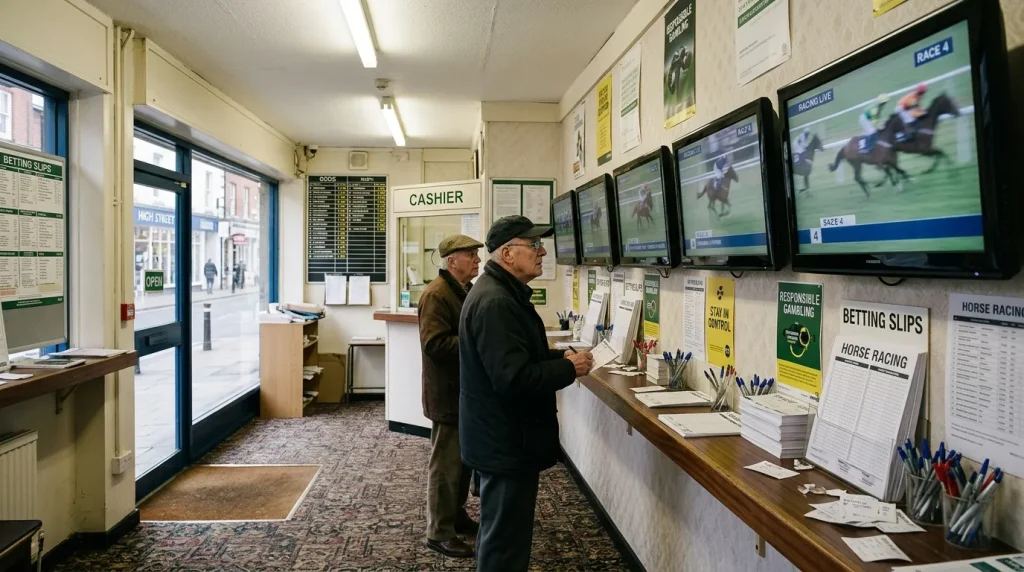
A decade ago, Britain had over 9,000 licensed betting shops. By March 2026, that number had fallen to 5,825 — a 36 per cent decline over ten years. In the same period, remote gambling’s share of the total British market rocketed from 16 per cent to roughly 60 per cent, according to a Social Market Foundation report. The shift is not a gentle trend. It is a structural transformation that has changed how the Triumph Hurdle and every other race is bet on, watched and experienced by millions of punters.
Shop Closures and the Growth of Online Horse Racing Betting
The Gambling Commission’s industry statistics for the financial year ending March 2026 record 5,825 licensed betting premises in Great Britain, a 1.8 per cent decrease from 5,931 the previous year. Since March 2020, the total has fallen by 18.7 per cent. The decline accelerated after the 2019 reduction in maximum stakes on fixed-odds betting terminals from £100 to £2, which removed a significant revenue stream from high-street shops.
Meanwhile, total gross gambling yield for the remote casino, betting and bingo sector reached £7.8 billion in FY2024-25 — a 13.1 per cent increase on the previous year. Remote betting alone generated £2.6 billion in GGY, with horse racing accounting for £766.7 million of that total. The numbers tell a clear story: the money has moved online, and the infrastructure of high-street betting is shrinking to match.
The BHA’s Q3 2026 Racing Report noted the consequences for racing directly. As the report stated: “This preference for our highest profile fixtures is undoubtedly linked to the impact of affordability checks with there being fewer larger staking customers, who have either stopped betting or are placing their bets elsewhere.” The shift to online has been accompanied by regulatory changes — particularly financial risk checks triggered at £150 net deposits per 30 days — that have pushed some bettors away from regulated operators entirely.
Why Mobile Dominates at Cheltenham
Over 80 per cent of Cheltenham Festival bets in 2026 were placed on mobile devices. That figure reflects a broader consumer habit — most online shopping, banking and media consumption has migrated to phones — but racing has specific features that make mobile particularly powerful.
Live streaming is one. Most licensed bookmakers offer free live streams of British and Irish racing to customers with funded accounts. During Cheltenham week, this means punters can watch the Triumph Hurdle on their phone, check in-play odds as the race unfolds, and place bets on subsequent races without leaving the app. The entire cycle — research, bet, watch, settle, repeat — happens in a single interface.
Odds comparison is another. Apps from oddschecker and individual bookmakers display real-time prices across multiple operators, allowing punters to shop for the best Triumph Hurdle price in seconds rather than walking between betting shops. Best Odds Guaranteed, which automatically upgrades your price if the starting price is higher than the odds you took, is almost universally offered by online operators but rarely available in-shop under the same terms. The difference in effective odds between an online bettor with BOG and a shop bettor without it can amount to several points on a 10/1 winner — and over a four-day Festival, those accumulated points represent a meaningful return gap.
NRNB ante-post offers are overwhelmingly online-only. William Hill’s headline NRNB from New Year’s Day, which set the pace for the industry, was available through its digital channels. Punters betting in-shop on the Triumph Hurdle typically cannot access the same range of ante-post protections that the online market provides. For a race as volatile as the Triumph — where the 2026 withdrawal of favourite Narciso Has reshaped the entire market days before the Festival — that protection has tangible financial value.
What This Means for Triumph Hurdle Punters
If you are betting on the Triumph Hurdle in 2026, the practical implications of the online shift are straightforward. First, your odds will almost certainly be better online than in-shop. The combination of BOG, enhanced place terms for each-way bets, and aggressive sign-up offers creates a pricing environment that the high street cannot replicate.
Second, your information will be more current. Mobile apps update odds in real time, display market movers instantly, and push notifications when significant non-runner announcements or jockey changes occur. Late withdrawals can reshape a juvenile hurdle market within minutes, and the bettor who sees the alert first has the widest choice of revised prices — an edge that compounds across a seven-race card.
Third, in-play betting on subsequent races becomes seamless. A winning Triumph Hurdle bet can be immediately reinvested into the County Hurdle or held in the account for the Gold Cup, with no physical movement required. The speed at which you can act on a result — adjusting your day-four strategy in response to how the opening race played out — is orders of magnitude faster online than it would be queueing at a betting window.
The Remaining Role of Betting Shops
Betting shops have not disappeared, and they retain specific advantages. On-course bookmakers at Cheltenham offer prices that are not available online, sometimes pushing to bigger odds on certain runners to attract volume from the crowd. The atmosphere of placing a bet face to face, on a racecourse surrounded by other punters, is a social experience that apps cannot replicate.
For some bettors, the shop serves a practical function too. Cash betting leaves no digital trail. Punters who have been restricted by online operators — account closures, stake limits, affordability check requests — sometimes return to cash-based high-street or on-course betting as the only unrestricted channel available to them. The on-course market at Cheltenham itself remains a vibrant, competitive environment where independent bookmakers push odds to attract business from the crowd, and where the atmosphere of live betting adds a dimension that no app can replicate.
But the numbers are unambiguous. Remote gambling now accounts for the majority of the market, mobile is the dominant device, and the tools available online — odds comparison, streaming, NRNB, BOG — make it the superior channel for Triumph Hurdle betting by every measurable metric. The high street retains charm and community; the phone delivers function and value. For most punters, that trade-off settled itself years ago.
