
Fred Winter Hurdle vs Triumph Hurdle: Two Juvenile Races, Different Signals
 Available in US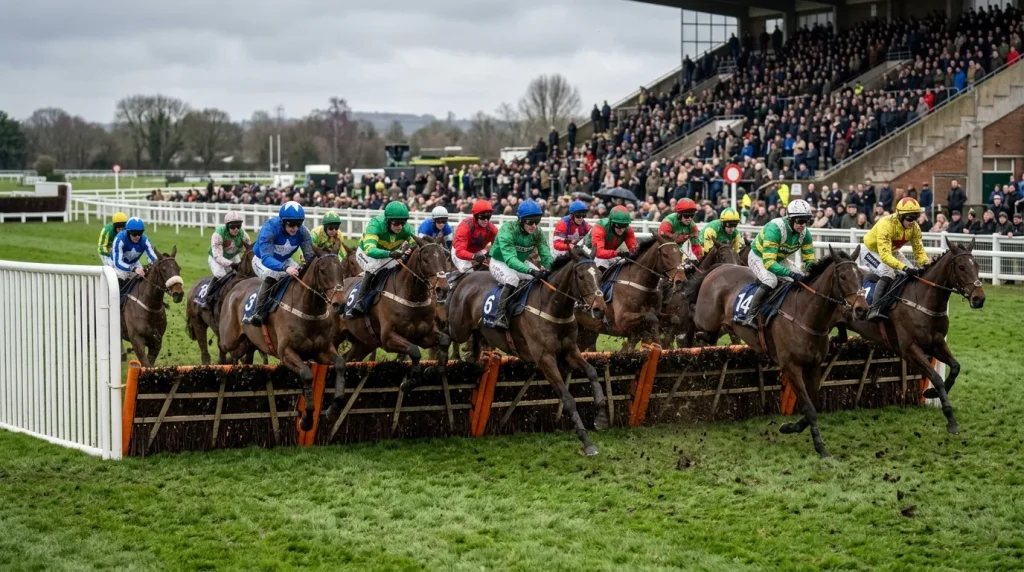
The Fred Winter Juvenile Handicap Hurdle shares a Festival card and an age group with the Triumph Hurdle, but the two races attract fundamentally different horses. One is a Grade 1 championship. The other is a handicap designed to give lower-rated four-year-olds their own shot at Cheltenham glory. Confusing the form between them — or failing to understand how one race’s existence changes the other — is a mistake that costs bettors money every March.
Race Conditions Compared
The Triumph Hurdle is a Grade 1 level-weights contest over two miles and one furlong on the New Course, restricted to four-year-olds. Every colt and gelding carries eleven stone; fillies receive a seven-pound allowance. There are no handicap marks, no ratings-based weight adjustments. The race rewards the best horse on the day, full stop.
The Fred Winter — formally the Boodles Juvenile Handicap Hurdle — is a Class 2 handicap over the same distance but on the Old Course, run on day one of the Festival. Runners are assigned weights by the BHA handicapper based on their official rating, with the highest-rated horse carrying the most weight and lower-rated runners receiving corresponding allowances. Fields are typically larger — often 20 or more — and the race is deliberately designed to be open and competitive.
The distinction matters because the form generated by each race has different reliability. A horse winning the Triumph Hurdle has beaten the best available juveniles under identical conditions. A horse winning the Fred Winter may have benefited from a lenient handicap mark, a favourable weight pull or a pace scenario that suited its running style. Both are achievements, but they signal different things about the winner’s true ability ceiling.
Form Crossovers Between the Two Races
Trainers with multiple juvenile hurdlers frequently enter horses in both races before deciding which contest each will target. A horse rated 130 might hold an entry in both the Triumph and the Fred Winter, with the final decision depending on how the handicapper assesses its mark and where connections believe it has the better chance.
Form crossover happens in both directions. A horse that was beaten in a Triumph Hurdle trial might drop into the Fred Winter if its connections feel the handicap route offers a more realistic opportunity. Conversely, a horse that won a Fred Winter trial impressively might be supplemented into the Triumph if connections believe it has outgrown its handicap mark.
The 2026 renewal illustrates this dynamic. Several runners — including some from the Mullins yard — held entries in both races through the early stages of the declaration process. The final allocation of horses between the two contests was not confirmed until the 48-hour declaration stage, and late switches between them can create sharp market movements as runners move from one race to the other.
For bettors, the crossover creates informational opportunities. If a horse initially entered in the Triumph is switched to the Fred Winter, that switch tells you the connections have assessed the horse as below Grade 1 standard — useful intelligence for evaluating the remaining Triumph field. If a Fred Winter entry is elevated to the Triumph, the reverse applies: connections are signalling that they believe the horse is better than its handicap mark suggests.
How the Fred Winter Reduced Triumph Fields
Before the Fred Winter’s introduction in 2005, the Triumph Hurdle regularly attracted fields of 25 or more. The race was often described as a cavalry charge — a large, chaotic contest where outsiders had a reasonable chance simply because the volume of runners created more opportunities for things to go wrong at the front of the field.
The Fred Winter changed that dynamic by providing an alternative target for the lower tier of the juvenile hurdling division. Horses rated between 110 and 130, who previously had nowhere else to go at the Festival, now had their own race. The Triumph field shrank accordingly, and the quality of the remaining runners increased. Since 2005, seventeen of the twenty-one Triumph Hurdle winners have returned a starting price of 10/1 or shorter — a compression that reflects smaller, classier fields where form is more exposed and longshots have fewer hiding places.
The number of horses in training across British racing fell to 21,728 in 2026, a 2.3 per cent decline from 2026 according to BHA data. That shrinking population further reduces the pool of potential Triumph Hurdle runners, reinforcing the post-2005 trend toward smaller, more predictable fields. The Fred Winter absorbs the next tier down, and the Triumph concentrates the genuine championship contenders.
The decline in jump horses rated 130 or above — down roughly 25 per cent between 2022 and 2026 — amplifies this effect. With fewer quality juveniles available, the Triumph field becomes more top-heavy. The best three or four runners dominate the market, and the remaining entries are there to make up numbers rather than to compete for the win. That top-heaviness favours form-based betting strategies over speculative plays on longshots.
Betting Implications: Which Race Offers Better Value?
The Triumph Hurdle’s smaller, classier field makes it a more predictable race — which is better for analytical bettors but worse for value seekers. The market prices the leading contenders tightly, and the overround on a fifteen-runner Grade 1 is lower than on a twenty-five-runner handicap. Finding a mispriced horse in the Triumph requires specific knowledge — trial form, trainer patterns, French import intelligence — that most of the market also possesses.
The Fred Winter, by contrast, is a handicap. Handicaps are inherently more open because the weight system is designed to equalise the field. A lightly raced horse with a potentially lenient mark can outperform its odds in ways that form analysis alone would not predict. For bettors who enjoy larger fields, each-way value at bigger prices and the chaos of a competitive handicap, the Fred Winter may actually offer better expected returns per pound staked.
The sharpest play is to analyse both races together. Use the Fred Winter entries to contextualise the Triumph Hurdle field. If a trainer switches a horse from Triumph to Fred Winter, the remaining Triumph runners gain by subtraction. If the Fred Winter form from Tuesday’s card is strong — a winner that beats subsequent Triumph entries — that form cross-reference upgrades or downgrades specific Triumph selections before Friday arrives. The two races are distinct, but they share an ecosystem. Reading both is how you read either one properly.
