
Cheltenham Going and Ground: How Conditions Shape the Triumph Hurdle
 Available in US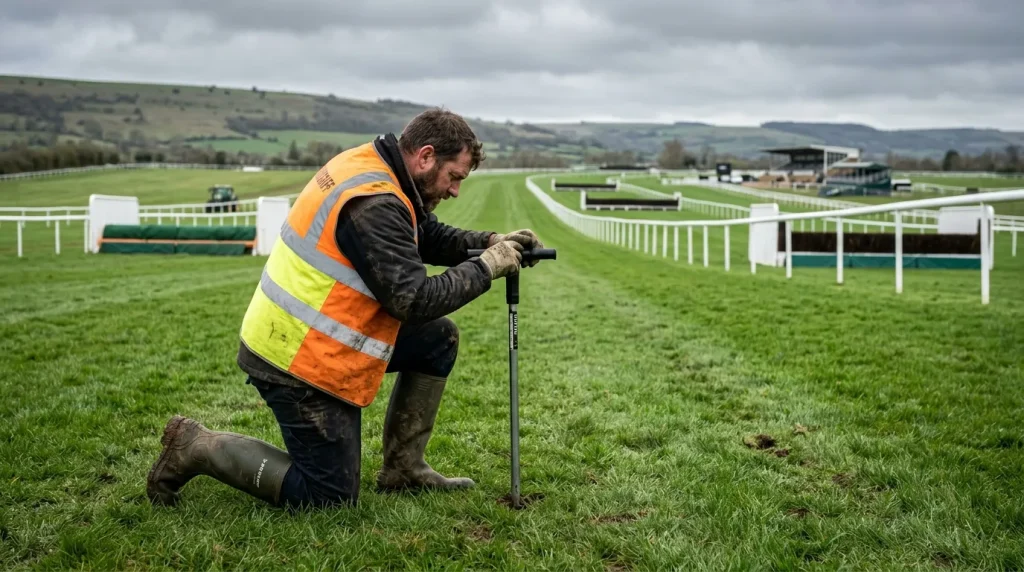
Ground conditions at Cheltenham in March range from good to soft through to genuinely heavy, and for four-year-old hurdlers who may have raced only two or three times, the going can determine whether a horse produces its best or struggles to finish. In the 2023-24 season, 71 per cent of all Jump races between January and April ran on soft or heavy ground — an extreme that reshaped trial form and altered the Triumph Hurdle market. Reading the ground report on race morning is not a formality. It is a variable that can invalidate weeks of form study in a single sentence.
Cheltenham’s Going Scale Explained
The going at British racecourses is described on a seven-point scale: firm, good to firm, good, good to soft, soft, soft to heavy, and heavy. Cheltenham’s New Course, where the Triumph Hurdle is run, has its own drainage characteristics. The track sits in a natural amphitheatre in the Cotswold Hills, and different sections drain at different rates. The bottom of the course, through the back straight, can ride softer than the top of the hill, where exposure to wind and gradient encourages faster drying.
BHA-appointed clerks of the course assess the going using a GoingStick — a mechanical device that measures ground resistance — supplemented by visual inspection and historical knowledge of how the track behaves under specific weather patterns. The official going description is published the evening before racing and updated on race morning, often with further revisions if overnight rain or morning sunshine materially changes conditions.
For the Triumph Hurdle, the most common going descriptions in March are good to soft and soft. Genuine good ground is rare — it requires a dry spell that the British spring seldom delivers. Heavy ground, while less common than at the winter meetings, has occurred at the Festival and dramatically alters the race’s character when it does.
Historical Going for Triumph Hurdle Day
Across the last decade of Triumph Hurdles, the going has been described as soft or softer in roughly half the renewals. Good to soft has featured in most of the remaining years, with only occasional meetings producing ground better than that. The 2026 Festival, for instance, ran on soft to heavy ground for much of the week after prolonged winter rainfall. The 2023 meeting was quicker — good to soft — which suited speed-oriented juveniles and contributed to a dominant front-running performance from Lossiemouth.
The practical lesson: any Triumph Hurdle selection should have demonstrated the ability to handle soft ground, or at minimum should not have shown an aversion to it. Horses whose form has been achieved exclusively on good ground at flat tracks or on quick-draining all-weather surfaces face a meaningful question mark at Cheltenham in March. That question mark rarely resolves in the bettor’s favour.
The total number of horses in training in Britain fell to 21,728 in 2026 according to the BHA 2026 Racing Report. Within that shrinking population, the pool of juvenile hurdlers with proven soft-ground form is smaller still. A horse that has both the rating and the ground preference for Cheltenham sits in a narrow band — and that scarcity is part of why French imports, bred for stamina on testing surfaces, continue to dominate this race.
How Ground Affects Juvenile Hurdlers
Soft ground turns the Triumph Hurdle into a stamina contest. Four-year-olds do not have the physical maturity of older horses, and ploughing through heavy ground for two miles and one furlong up a hill exhausts them faster. Horses who jump efficiently — conserving energy at each flight rather than leaping extravagantly — gain a compounding advantage as the race progresses. Every wasted effort at a hurdle on soft ground costs more than it would on good ground, and by the time the field turns into the straight, the efficient jumpers have margins that the flashy ones cannot close.
French-bred runners thrive in these conditions. Their breeding emphasises stamina. Their early education at Auteuil, where soft ground is standard, prepares them for the demands of a testing Cheltenham surface. As Ruby Walsh has noted, all the structural changes in the sport are designed to attract the best horses to the Festival — and for the Triumph Hurdle, “the best” increasingly means those recruited from France specifically because they handle the kind of ground Cheltenham typically produces.
Conversely, flat-bred recruits and horses whose form was achieved on good ground face the greatest risk on soft going. A horse that won a bumper at a summer evening meeting on fast ground is not the same animal when knee-deep in Cheltenham mud. The transition is too great to make reliably in a single step, and the Triumph Hurdle is not the place to find out whether it can cope.
Total prize money across British racing reached a record £194.7 million in 2026 — high enough to attract runners from major yards regardless of conditions. That means the field does not thin when the ground is testing. The quality remains, but the hierarchy within it shifts. Ground-dependent selection is not an optional refinement. It is a core part of Triumph Hurdle analysis.
Checking the Going: When and Where to Look
The BHA publishes going reports through its website and via racecourse social media channels. The evening-before report gives you the overnight picture. The morning-of-race update, typically issued between 7 am and 9 am, incorporates overnight conditions and provides the description that most influences final betting decisions.
At Cheltenham, the clerk of the course often provides a verbal update to the media around 8 am on race morning, which racing journalists relay on social media. These updates sometimes include information not yet reflected in the official description — for instance, that the ground is drying faster than expected or that localised rain has affected one section of the course.
For the Triumph Hurdle, the ideal approach is to check the going at three points: the evening before, the morning of, and again around noon when any final revisions are published. If the going changes between your initial assessment and race time — say from good to soft to soft — reassess any selection whose form was achieved exclusively on quicker ground. The racecard does not change in the final hours, but the conditions it is run on can. That late-shifting variable is where prepared bettors separate themselves from the crowd backing last night’s price without checking this morning’s ground.
