
Poniros at 100/1: Triumph Hurdle Upset
 Available in US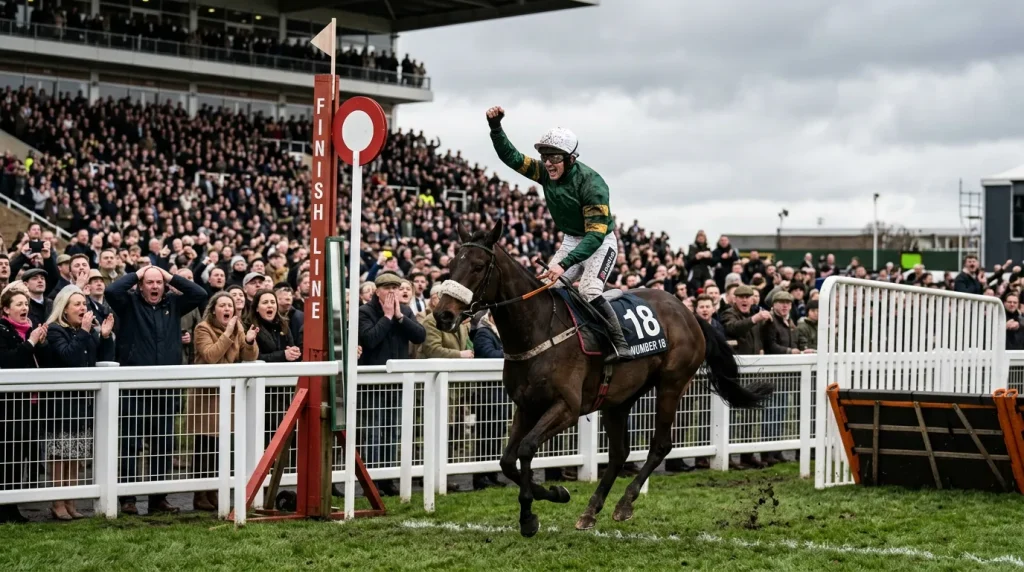
When Poniros crossed the line first in the 2026 Triumph Hurdle, the reaction at Cheltenham was not a roar but a silence. The kind of silence that settles over a crowd when nobody is quite sure what just happened. At 100/1, a horse who had never jumped a hurdle in public had just beaten two of the most talked-about juveniles in training. Willie Mullins, who trained eleven of the seventeen runners that afternoon, reportedly turned to someone near him and asked: “Is that one of mine?” It was. And it was the longest-priced winner in the history of the race.
Pre-Race Odds: Mullins Runners and the Triumph Hurdle Favourite
The 2026 Triumph Hurdle field numbered seventeen. Eleven of them carried the Closutton form tag. That level of single-yard saturation had become familiar — Mullins had run seven in 2023 and produced the first four home — but eleven from seventeen was a new frontier. The market, understandably, centred on the horses with proven hurdle form. East India Dock, trained by Nicky Henderson, had won the Grade 2 Triumph Hurdle Trial at Cheltenham over course and distance in January and went off the 5/4 favourite. Lulamba, also Henderson-trained, was second in the betting at around 11/4 after an impressive Ascot debut.
Poniros was not part of any conversation. His career to that point consisted entirely of flat racing, including a run at Royal Ascot where he had finished well in front of East India Dock in a handicap over a mile and a half. That form line was publicly available, but almost nobody connected it to the Triumph Hurdle. He had never schooled over a hurdle in competition. His price reflected exactly what the market thought of that profile: 100/1, the outsider of the outsiders, cloth number irrelevant.
The jockey booking told a different story to those paying attention. Jonjo O’Neill Jr had not ridden a Festival winner since Early Doors in the Martin Pipe in 2019. That drought ended the previous afternoon when he won the TrustATrader Plate Handicap Chase on Jagwar for Oliver Greenall and Josh Guerriero. The momentum shift was intangible but real. And Mullins does not waste Festival jockey bookings on horses with no chance.
The Race: How Poniros Ran Them Down
The early pace was honest without being suicidal. East India Dock went forward as expected, jumping cleanly and establishing a prominent position through the first mile. Lulamba tracked him, travelling easily. The Mullins contingent spread across the field in clusters, each ridden to individual instructions, none obviously sacrificing position for a stablemate.
Poniros was held up at the back. Through the first half of the race, he was invisible — just another green-jacketed runner in a pack of green jackets. His jumping was functional rather than fluent, which was hardly surprising given he had never done it before under competitive pressure. But he was economical. He did not waste energy at the flights, and he did not pull against O’Neill’s hold.
The race changed between the second-last and the last hurdle. East India Dock’s stride began to shorten on the hill. Lulamba moved into contention and looked the likely winner turning for home. Behind them, Poniros was making ground with every stride, moving through beaten horses the way a flat-bred stayer does when stamina kicks in and speed drops away around him. He hit the front inside the final hundred yards, got a neck ahead of Lulamba, and held on. The favourite finished third, two lengths back, his course-and-distance form rendered meaningless by the chaos of the final furlong.
Aftermath: What Bookmakers Lost and Bettors Won
At 100/1, the each-way returns were extraordinary. A ten-pound each-way bet on Poniros at standard one-quarter odds returned £1,010 for the win portion and £260 for the place — a total return of £1,270 from a twenty-pound outlay. For the small number of punters who had backed him, it was a life-changing result from a race that most treated as an afterthought to the Gold Cup.
For the bookmaking industry, the result was a material event. The Horserace Betting Levy Board reported a record levy yield of approximately £108 to £109 million for the financial year ending March 2026, and the HBLB noted that race results at the Cheltenham Festival were a significant factor in that outcome. Poniros’s victory — which cost the layers heavily on each-way multiples and accumulators — was one of the results that shaped the Festival’s profit-and-loss picture for the entire industry.
Dom Crosthwaite, Flutter Entertainment’s Chief Trading Officer, described the 2026 Cheltenham week in these terms: “We delivered a great customer proposition for our flagship brands, with a series of recent product upgrades and marketing campaigns driving strong staking levels of well over £250m.” That staking volume, spread across brands including Paddy Power, Betfair and Sky Bet, absorbed the Poniros shock as one result among 28 races. But for traders managing risk on individual contests, Gold Cup day’s opening race had just delivered the worst possible start.
Lessons for Bettors: When Outsiders Strike
The temptation after a 100/1 winner is to conclude that anything can happen in the Triumph Hurdle. Technically true. Practically unhelpful. Poniros did not win because the formbook collapsed — he won because a specific set of conditions aligned.
First, he had relevant flat form that the market undervalued. His Royal Ascot run, where he beat East India Dock at level weights over a mile and a half, demonstrated stamina and class. The market priced him as a hurdling novice, which he was. But it ignored the flat form that suggested he had the raw engine for two miles on a hill.
Second, he belonged to a trainer who fields runners at 100/1 not as charity entries but as live options. Mullins’s squad approach means that even the eleventh runner receives a professional preparation. Poniros had been schooled privately, assessed against stablemates, and sent to Cheltenham because the yard believed he was capable of competing, not just participating.
Third, the jockey was in form. O’Neill Jr’s TrustATrader Plate win the previous afternoon was not causally connected to Poniros’s victory, but it speaks to the psychological dimension of race-riding. A jockey who has just broken a long winning drought rides with less tension and more instinct. That matters when you are on a 100/1 shot who needs a perfectly timed run.
The practical lesson is not “back every Mullins outsider” — that way lies bankruptcy. It is to respect the multi-runner dynamic. When a dominant yard enters nearly half the field, the second and third strings are not makeweights. They are live runners with private form that the market cannot see. The estimated total industry betting turnover for the 2026 Cheltenham Festival stands at around £450 million, according to William Hill. A portion of that money will be wasted on short-priced favourites in the Triumph Hurdle who get beaten by a stablemate nobody fancied. Poniros proved that the system produces those results. The question for bettors is whether they will be on the right side next time.
