
Tiger Roll’s Triumph Hurdle Win: Where a Legend’s Journey Began
 Available in US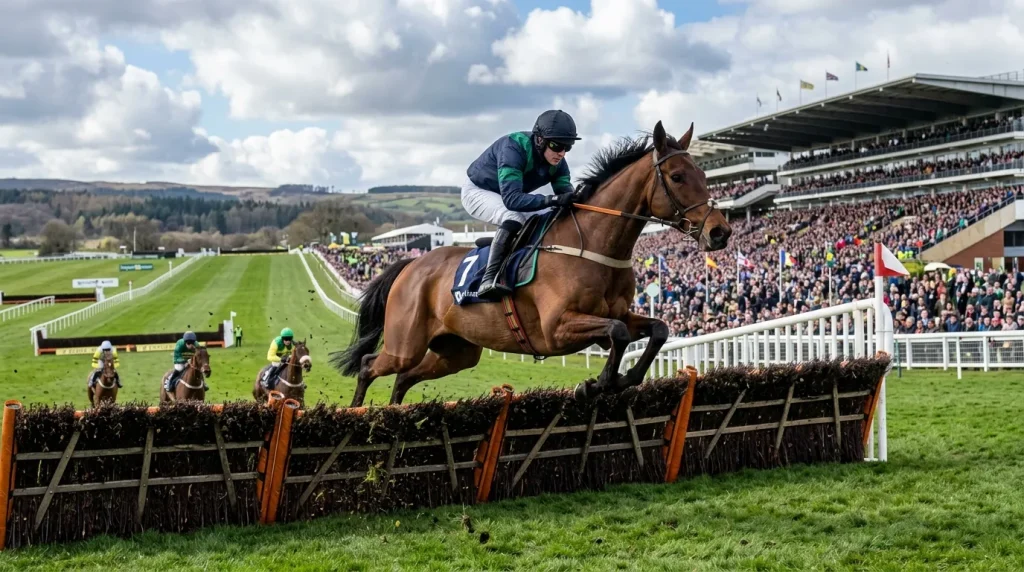
When Tiger Roll won the 2014 Triumph Hurdle at 10/1, he was a lightly regarded four-year-old from Gordon Elliott’s yard whose career ceiling was anyone’s guess. Within five years, he had won two Grand Nationals, three Cross-Country Chases and five Cheltenham Festival races in total. No horse in modern National Hunt history has built a more improbable career from a Triumph Hurdle foundation, and his juvenile victory offers a template for spotting the kind of horse that uses the race as a launchpad rather than a peak.
The 2014 Race: Davy Russell and a Statement Win
Tiger Roll was the first runner at the 2014 Festival for trainer Gordon Elliott, who was building the Cullentra House operation into the force it would become. The horse was a compact, tough gelding — not physically imposing, not flashy, but honest. Partnered by Davy Russell, he tracked the pace through the first mile, moved smoothly into contention turning for home, and pulled clear on the hill to win by three and a quarter lengths.
The margin was emphatic for a Triumph Hurdle. Most renewals are settled by a length or less. Tiger Roll’s superiority on the day suggested that his official rating at the time — around 140 — understated his ability, which was confirmed when the handicapper reassessed him after the performance. Russell’s ride was a model of Cheltenham efficiency: patient early, progressive from the second-last, and relentless up the hill. It was the jockey’s course knowledge, combined with the horse’s attitude, that separated Tiger Roll from a field of sixteen rivals.
The starting price of 10/1 reflected the market’s uncertainty about a horse with limited form over hurdles. Tiger Roll had won a maiden hurdle at Navan and finished third in a graded race at Leopardstown, but neither performance had suggested he was a Grade 1 animal. The Triumph Hurdle revealed qualities — stamina, toughness, an ability to handle the Cheltenham terrain — that flat form and maiden hurdle runs cannot fully measure. The market got the general direction right — he was not the favourite — but it underpriced his ceiling, which is exactly the kind of error that Triumph Hurdle bettors should learn to exploit when they see a similar profile in future renewals.
What Came After: Cross-Country, Grand National, Legend
Tiger Roll’s post-Triumph career defied every conventional pathway. Rather than progressing through the Champion Hurdle or Stayers’ Hurdle route, he was switched to chasing, struggled briefly, then found his niche in the Cross-Country Chase at the Cheltenham Festival — a unique race run over a figure-of-eight course incorporating banks, ditches and varied terrain. He won it three times, in 2018, 2019 and 2021.
In between Cross-Country victories, he won back-to-back Grand Nationals at Aintree in 2018 and 2019. The first was achieved off a mark of 150, carrying 10st 13lb. The second came off a mark of 159, carrying 11st 5lb — a nine-pound rise that reflected his growing stature but could not prevent him from becoming the first horse since Red Rum to win consecutive Nationals. A planned hat-trick was denied by the 2020 pandemic cancellation and then by disputes over the weight he would have been allocated in subsequent years.
Five Cheltenham Festival victories in total. Two Grand National victories. A career that generated newspaper front pages, pub debates and the kind of public recognition normally reserved for flat racing superstars. British racecourse attendance exceeded five million in 2026 — the highest since 2019 — and horses like Tiger Roll played a meaningful role in building the audience that sustains those numbers today. His Triumph Hurdle victory was not his most famous race. But it was the one that put him on the trajectory.
Triumph Hurdle as Career Launchpad
Tiger Roll’s path from the Triumph to the Grand National is the most dramatic example of the race’s role as a career identifier, but it is not the only one. Defi Du Seuil won the 2017 Triumph and became one of the best two-mile chasers of his generation, winning the Tingle Creek Chase and the Champion Chase. Lossiemouth won the 2023 Triumph and established herself in the Mares’ Hurdle division, winning again at the 2026 Festival. Vauban won the 2022 Triumph and was switched to the flat, eventually winning the Lonsdale Cup at York.
The common thread is versatility. Triumph Hurdle winners are four-year-olds with their entire careers ahead of them, and the race’s Grade 1 status confirms a level of talent that can be deployed across multiple disciplines. The best Triumph graduates are not one-dimensional hurdlers — they are athletes whose initial two-mile hurdling ability is a starting point, not a ceiling.
What separates Tiger Roll’s trajectory from the others is the sheer range. From a juvenile hurdle to a Cross-Country Chase to a Grand National requires a horse to adapt to completely different tests of speed, stamina, jumping technique and tactical awareness. Few horses can do it. The Triumph Hurdle identified Tiger Roll’s core qualities — toughness, ground-handling, tactical intelligence — before anyone, including his connections, knew how far those qualities would take him. The race is a talent screen, and Tiger Roll is the ultimate case study in what that screen can detect.
The Cheltenham Festival contributes an estimated £274 million to the Gloucestershire economy according to a University of Gloucestershire study. A significant portion of that value derives from the Festival’s ability to produce stars who sustain public interest across multiple seasons. Tiger Roll did that more effectively than any horse of his generation, and his story began on Gold Cup Day 2014 at 1:20 pm.
What Tiger Roll Teaches Triumph Hurdle Bettors
Three lessons endure. First, the Triumph Hurdle can be won by a horse whose pre-race form does not scream Grade 1 winner. Tiger Roll was 10/1, not 2/1. His maiden hurdle form at Navan was useful, not spectacular. The race elevated him beyond what his existing record suggested — which means that bettors who only back the obvious form horses are systematically undervaluing the improvers.
Second, the trainer-jockey combination matters more than the horse’s reputation. Elliott and Russell had a Festival plan, a tactical approach (patient, late) and the confidence to execute it on a horse that the wider market underrated. Backing runners whose connections have a demonstrated Festival methodology is a more reliable filter than backing the horse with the biggest reputation.
Third, the Triumph Hurdle winner is worth following beyond March. Tiger Roll’s post-Triumph career generated returns for anyone who tracked his progress and backed him at value in subsequent seasons. The 2014 Triumph was a £1 race for those who bet on it. The Grand National and Cross-Country victories that followed were the real payoff — built on the foundation of a juvenile race that identified Tiger Roll’s potential before the rest of the world caught up.
